Windows | INVALID CLASS ERROR | CMD | SYSTEMINFO | DRIVERS | WMI | Windows Management Instrumentation service | Clase no valida | Cómo reparar WMI
Windows | INVALID CLASS ERROR | CMD | SYSTEMINFO | DRIVERS
Error cuando ejecuto aplicaciones o en el sistema Operativo:
System.Management.ManagementException Invalid class
Se debe realizar lo siguiente:
Inicie el complemento WMI MMC en Inicio -> Ejecutar -> luego ingrese WMIMGMT.MSC
Haga clic con el botón derecho en Control WMI (local) y haga clic en Propiedades

Si WMI funciona correctamente, mostrará Buenas propiedades. Si ve una clase no válida, entonces su WMI no está funcionando correctamente.
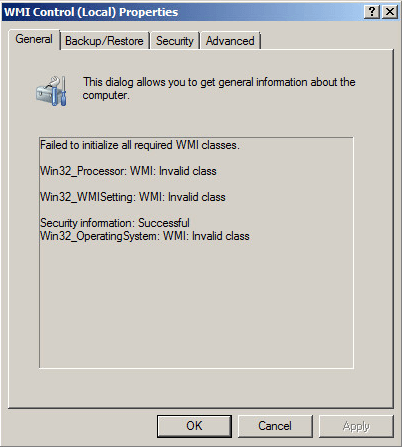
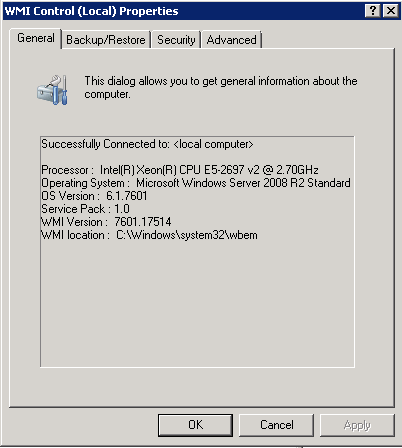
Solución de problemas:
Winmgmt.exe /standalonehost
Winmgmt.exe /resetrepository
Una vez terminado, revise WMIMGMT.MSC para ver si está completando las Propiedades correctamente.

https://techcommunity.microsoft.com/t5/ask-the-performance-team/wmidiag-2-2-is-here/ba-p/375642


reg add HKLM\SOFTWARE\Microsoft\Ole /v EnableDCOM /t REG_SZ /d “Y” /f
reg add HKLM\SOFTWARE\Microsoft\Ole /v LegacyAuthenticationLevel /t REG_DWORD /d “2” /f
reg add HKLM\SOFTWARE\Microsoft\Ole /v LegacyImpersonationLevel /t REG_DWORD /d “3” /f
reg delete HKLM\SOFTWARE\Microsoft\Ole /v DefaultLaunchPermission /f
reg delete HKLM\SOFTWARE\Microsoft\Ole /v MachineAccessRestriction /f
reg delete HKLM\SOFTWARE\Microsoft\Ole /v MachineLaunchRestriction /f
NET STOP SharedAccess
NET STOP winmgmt
CD %WINDIR%\System32\Wbem\Repository
DEL /F /Q /S %WINDIR%\System32\Wbem\Repository\*.*
CD %WINDIR%\system32\wbem
REGSVR32 /s %WINDIR%\system32\scecli.dll
REGSVR32 /s %WINDIR%\system32\userenv.dll
MOFCOMP cimwin32.mof
MOFCOMP cimwin32.mfl
MOFCOMP rsop.mof
MOFCOMP rsop.mfl
FOR /f %%s IN (‘DIR /b /s *.dll’) DO REGSVR32 /s %%s
FOR /f %%s IN (‘DIR /b *.mof’) DO MOFCOMP %%s
FOR /f %%s IN (‘DIR /b *.mfl’) DO MOFCOMP %%s
MOFCOMP exwmi.mof
MOFCOMP -n:root\cimv2\applications\exchange wbemcons.mof
MOFCOMP -n:root\cimv2\applications\exchange smtpcons.mof
MOFCOMP exmgmt.mof
rundll32 wbemupgd, UpgradeRepository
NET STOP Cryptsvc
DEL /F /Q /S %WINDIR%\System32\catroot2\*.*
DEL /F /Q C:\WINDOWS\security\logs\*.log
NET START Cryptsvc
cd c:\windows\system32
lodctr /R
cd c:\windows\sysWOW64
lodctr /R
WINMGMT.EXE /RESYNCPERF
msiexec /unregister
msiexec /regserver
REGSVR32 /s msi.dll
NET START winmgmt
NET START SharedAccess
Ejecute los siguientes comandos en un símbolo del sistema elevado en la máquina cliente que está generando los errores de corrupción de WMI. Esta es una forma alternativa de restablecer el repositorio de WMI al estado inicial cuando se instaló el sistema operativo por primera vez:
Winmgmt.exe / resetrepository
Winmgmt.exe / salvagerepository
Comentarios
Publicar un comentario
Las dudas y el agradecimientos, nos ayudan a mejorar a diario...